


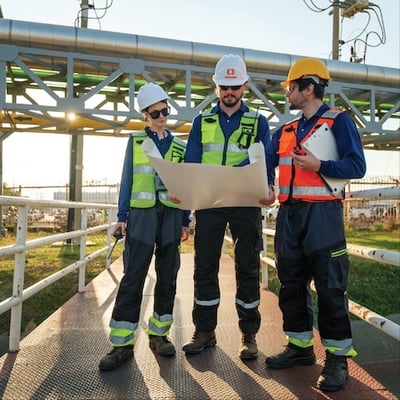
A project team needs space near the work. Maybe it’s a contractor’s office, a permitting trailer, a meeting room or just a place for supervisors to coordinate their daily activities. A conventional jobsite trailer is usually a fast solution. For many teams, it’s familiar, readily available and easy to place.
But in a refinery, chemical plant, LNG facility or other hazardous industrial site, convenience isn’t the only factor. If people will occupy the building, the facility must consider where the building sits in relation to blast, fire, toxic release, and other site-specific hazards.
That’s where conventional jobsite trailers are difficult to justify. They may be appropriate in many construction environments, but they’re not designed for areas that may experience blast events. Before placing people in any temporary or semi-permanent workspace, the question to ask is if the occupied building matches the facility siting requirements for that location.
Facility Siting Requirements Apply to Occupied Buildings, Not Just Permanent Structures
It’s important to remember that facility siting is about occupied buildings, not just permanent structures. If people are assigned to work, meet, rest or coordinate activity inside a building, that structure is part of the facility’s risk picture.
That distinction matters because many buildings brought onto industrial sites aren’t meant to be permanent. Some are used for just a few weeks during a project; other buildings stay in place for months or years because their use evolves or because they solve an ongoing space problem. Either way, temporary status does not remove the need to evaluate exposure. If people are inside it, the building must be evaluated based on the hazard exposure and how it will perform.
Why Conventional Jobsite Trailers Become a Problem in Hazardous Areas
Conventional jobsite trailers provide fast, flexible space, but their strengths become limitations in hazardous industrial areas. A standard trailer may provide workspace, but it’s not suitable for use in areas where blast, fire, or toxic release are possible. Here’s why:
1. Jobsite Trailers Are Not Designed for Blast Loads
Conventional trailers aren’t engineered to resist defined overpressure and impulse levels. A blast-resistant building is engineered around pressure, impulse and response criteria. If the proposed location requires protection from a blast event, the building needs to be evaluated against those conditions rather than assumed acceptable because it provides enclosed workspace.
2. Jobsite Trailers Often Lack a Verified Load Path
In blast-resistant design, structural performance depends on maintaining a continuous load path throughout the building system. Loads created by a blast event must transfer through the walls, roof, floor, connections and anchorage in a predictable way.
Conventional jobsite trailers are not engineered around those requirements. They lack the structural continuity needed to survive a blast load. To put it in other words, the connections between framing members, wall assemblies and support systems weren’t intended to resist transient overpressure forces.
3. A Jobsite Trailer's Windows, Doors, Connections and Anchorage are Weak Points
Blast performance depends on the entire building envelope working together as a system. Doors, windows, wall penetrations, structural connections and anchorage conditions all influence how the building responds under load.
Conventional trailers are generally designed for accessibility, portability and fast deployment. Openings, connection points, and anchorage systems aren’t engineered to resist the pressure and deformation demands associated with a blast event. Under those conditions, if one portion of a structure’s envelope fails, the overall response of the structure changes significantly.
The Facility Siting Study Drives the Occupied Building Decision
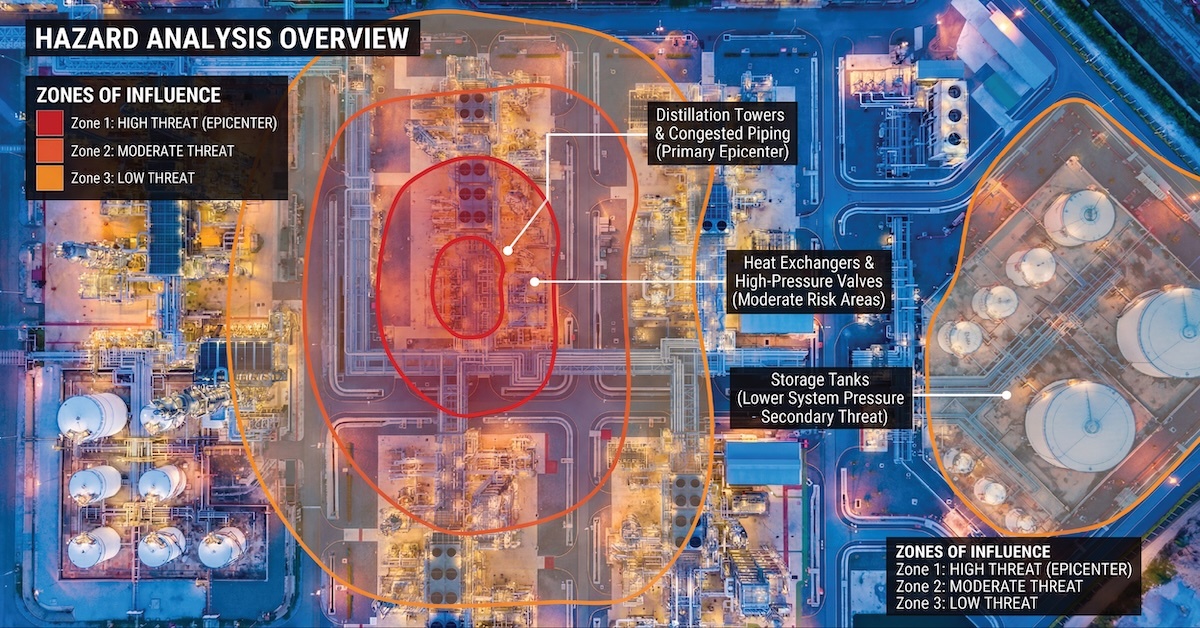
 A facility siting study helps identify how process hazards may affect occupied buildings and personnel across a site. That evaluation may include blast overpressure, thermal exposure, toxic release scenarios, occupancy levels and the expected duration of personnel exposure.
For permanent occupied buildings, facilities often reference API RP 752, which addresses the management of hazards associated with permanent process plant buildings. For portable and temporary occupied structures, API RP 753 provides guidance for siting portable buildings in process plant environments. API RP 756 may also apply when tents or soft-sided temporary structures are considered during maintenance or turnaround activity.
These documents reinforce an important principle: occupied building decisions should be based on site-specific hazard exposure, personnel risk and expected building performance — not simply whether a structure is temporary, portable or readily available.
When a Conventional Jobsite Trailer May Still Be Acceptable
Conventional jobsite trailers can serve an important role across industrial construction and maintenance projects. In areas where facility siting evaluations do not identify blast, fire or toxic exposure concerns for occupied personnel, a standard trailer may provide an appropriate workspace solution.
For areas that need something more rugged than a conventional trailer, but do not require a blast-resistant building, portable modular steel offices, and office/storage combinations may provide a practical middle ground. SiteBox Storage, a RedGuard sister company, supports these types of non-blast applications with steel worksite buildings and storage solutions designed for demanding commercial and industrial environments.
The key issue is whether the occupied building matches the hazard conditions associated with its proposed location and use.
When People Need to Work Near Hazard Zones
Some projects require personnel to work near active process areas for operational, maintenance or turnaround reasons. In those situations, facilities may need occupied space that aligns more closely with identified hazard conditions.
Blast-resistant buildings are engineered around site-specific design requirements, including anticipated blast loads, occupancy needs and deployment constraints. Depending on the application, these buildings may also incorporate additional considerations related to fire exposure, toxic release scenarios, HVAC protection strategies and life safety systems.
In these environments, blast-resistant buildings may support functions like:
-
turnaround offices
-
safety meeting rooms
-
contractor coordination space
-
permit offices
-
break rooms
-
control or operations support space
The appropriate solution depends on the facility siting evaluation, occupancy profile and duration of use. The goal is to provide occupied space that aligns with the hazards associated with that area of the facility.
LeaseFleet and Temporary Occupied Building Planning
Industrial facilities often need temporary occupied space for turnarounds, outages, maintenance work, capital projects and operational support. Often, these demands don’t justify a permanent building. At the same time, that space must align with facility siting requirements while the work is performed.
RedGuard’s LeaseFleet provides blast-resistant buildings that can be deployed for temporary project use, including contractor coordination, permitting, supervision and operations support functions. Instead of relying on a conventional trailer in a hazardous area, facilities can use occupied buildings engineered for defined site conditions and project requirements.
Because project timelines, occupancy levels and hazard exposures vary by site, blast-resistant building planning should begin early in the project planning process. Coordination between operations, safety, engineering and contractors can help determine where occupied personnel should be located and what type of building performance is appropriate for that environment.
Questions to Ask Before Placing a Jobsite Trailer in a Process Facility
Before placing a conventional jobsite trailer in a refinery, chemical plant, LNG facility or other process environment, the project team should confirm whether the location and use align with the facility siting requirements for that site. The right questions can help determine whether a standard trailer is acceptable, whether the function should be moved farther from the hazard or whether a different type of occupied building is needed.
Important questions about facility siting requirements include:
-
Will people occupy this trailer during normal operations, maintenance, construction or project work?
-
Does the facility have a siting study that includes the area for placement?
-
If so, have any processes or other criteria changed since the last siting study?
-
Does the identified area include potential blast, fire or toxic release exposure concerns?
-
What overpressure, impulse or response criteria apply to this location?
-
Can the function be moved farther from the hazard instead of placing personnel in that area?
- If the building is portable or temporary, does the facility need to consider API RP 753, 756 or other applicable siting guidance?
Facility Siting Decisions Should Come Before Trailer Placement
In a process facility, occupied building decisions should follow the facility siting evaluation. That evaluation helps determine whether a standard trailer, or a modular steel building is acceptable, whether the occupied function should be moved farther from the hazard or whether a blast-resistant building is needed.
The facility personnel should understand the exposure, occupancy and expected building performance. That sequence protects the team, supports compliance with facility siting requirements and helps prevent a temporary space decision from becoming a safety concern.
Need temporary occupied space that aligns with your facility siting requirements? Talk with RedGuard about LeaseFleet blast-resistant buildings for outages, capital projects, maintenance work and operational support.