

Maximizing ROI and safety with blast resistant modular buildings

This content was originally published in the September/October 2025 issue of BIC Magazine and on the BIC website. It's presented here in its original format.
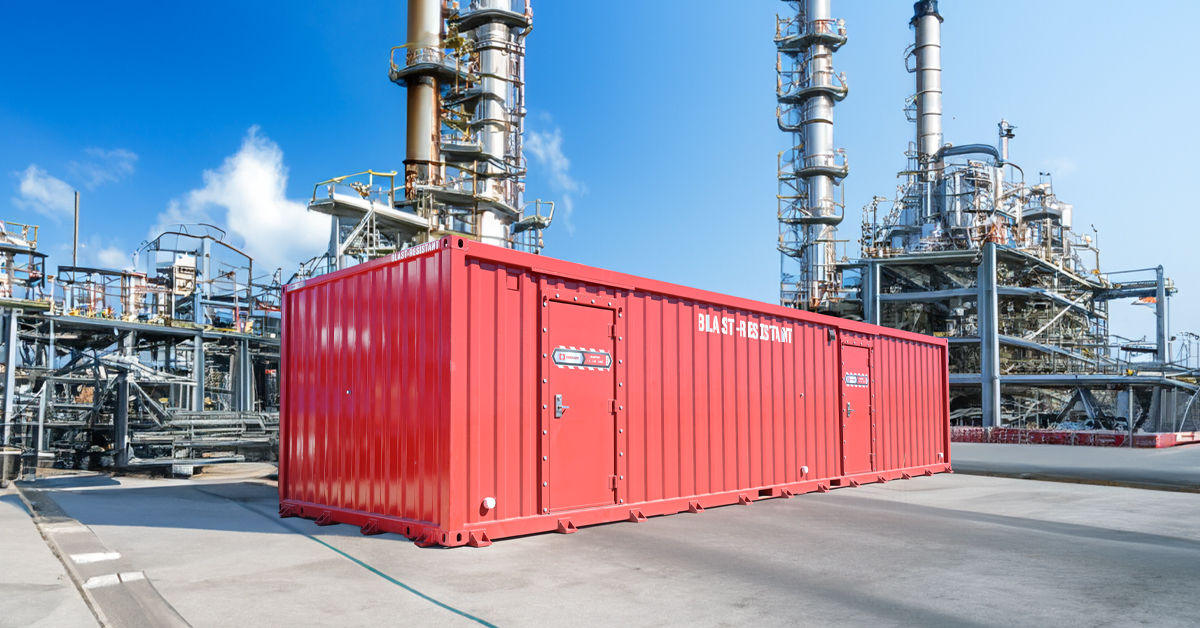
At the recent Downstream USA Conference in Houston, my colleague Eric Reinbolt and I had the opportunity to host a session, alongside Joe Jackson, a retired turnaround consultant formerly with LyondellBasell, titled, “Are blast shelters the best ROI for improving safety and logistics efficiency?” That session inspired this article, a reflection on how much our industry has evolved. Safety is no longer a point of debate; it’s the baseline. Our conversation revolved around safety measures that support efficiency and budget goals. Blast-resistant modular buildings (BRMs) have emerged as a smart investment, offering a measurable return while delivering unmatched safety.Traditional tents and trailers still serve a purpose, but they fall short when it comes to full-time occupancy in exclusion zones. Tents aren’t designed for blast protection, lack insulation and are expensive to heat and cool. Trailers are typically placed far from the worksite, forcing crews to walk long distances for meetings, breaks or shelter.
By contrast, BRMs can be sited much closer to live units, within or adjacent to exclusion zones, while still meeting blast safety requirements. This proximity reduces unproductive travel time, which is especially critical during a turnaround when hundreds or even thousands of workers move in and out of the field daily. Closer placement means faster shift changes, quicker access to control rooms and less downtime. With BRMs, this can all be done without compromising safety.
When you evaluate BRMs through the lens of productivity, the cost case becomes clear. RedGuard has developed tools to help owners assess this impact, calculating the time saved and labor efficiency gained. That assessment becomes even more compelling when comparing operating costs. Unlike tents, BRMs are built with insulation and HVAC systems that maintain the interior climate at a fraction of the energy cost. And in unpredictable conditions like heavy rain or extreme heat, BRMs offer a stable environment that tents and trailers simply can’t match.
In a recent turnaround, one BRM was placed in a nearby parking lot and remained fully operational despite weather that rendered the tented lunch area temporarily unusable. Details like elevation, flooring and drainage matter. BRMs are designed to account for all of them.
From basic shelter to engineered infrastructure
Modern BRMs have evolved over time. RedGuard has designed units for use as field offices, control rooms, restrooms, lockout/tagout stations and even multi-level, stackable complexes with kitchens and conference space. For capital projects or long-term site integration, they can be equipped with redundant systems, integrated controls and advanced HVAC.
Design evolution has followed market demand. What began as 1 psi-rated shelters following the 2005 Texas City refinery explosion — a tragic event that highlighted the need for stronger blast protections — soon improved to 5 psi, and then 8 psi. In the last five years, this number has reached today’s 10 psi structures, which are designed and tested to perform in higher blast zones. RedGuard’s latest round of life testing involved 23 psi reflected pressure impacts, which is far beyond most expected conditions, and the BRMs remained structurally sound. That’s not just engineering. That’s peace of mind.
Built for the real world: Flexibility, safety and strategy
BRMs have also proven adaptable as safety expectations shift. Facilities are increasingly placing personnel further from hazards, but they still require access for essential operations. BRMs make that balance possible. They can meet safety criteria while keeping crews close enough to stay productive. For space-constrained sites, stackable BRMs reduce footprint without sacrificing function. But stacking must be engineered and validated through testing, not just modeling. RedGuard has invested in both to ensure structural integrity and safety under realistic blast conditions.
Many BRMs now support “shelter-in-place” scenarios, with systems that detect external threats and trigger automatic HVAC shutdowns. While emergency procedures vary by facility, these buildings are designed to integrate with existing procedures and provide a safe environment in the event of toxic gas release or other hazards. As environmental loads grow more complex, with events like seismic risks, high winds or storm threats, BRMs can be engineered accordingly, or supplemented with dedicated storm shelter modules.
Early planning, smarter outcomes
In turnaround planning, timing and placement are everything. Bringing BRM vendors into the conversation early allows for better site integration, clearer cost modeling and safer, more efficient outcomes. At RedGuard, our focus isn’t just on delivering a building. It’s about delivering the right building, in the right place, for the right result.
For more information, visit RedGuard online or call (855) 733-4827.

Phillip Lange
Phillip Lange is the technical sales manager at RedGuard. With his experience working with companies in the oil and energy industry, his specialties include process scheduling, negotiation, budgeting, value engineering, and operations management. He oversees technical engineering services that are offered at RedGuard, like facility siting studies, building retrofits and custom blast-resistant solutions.