

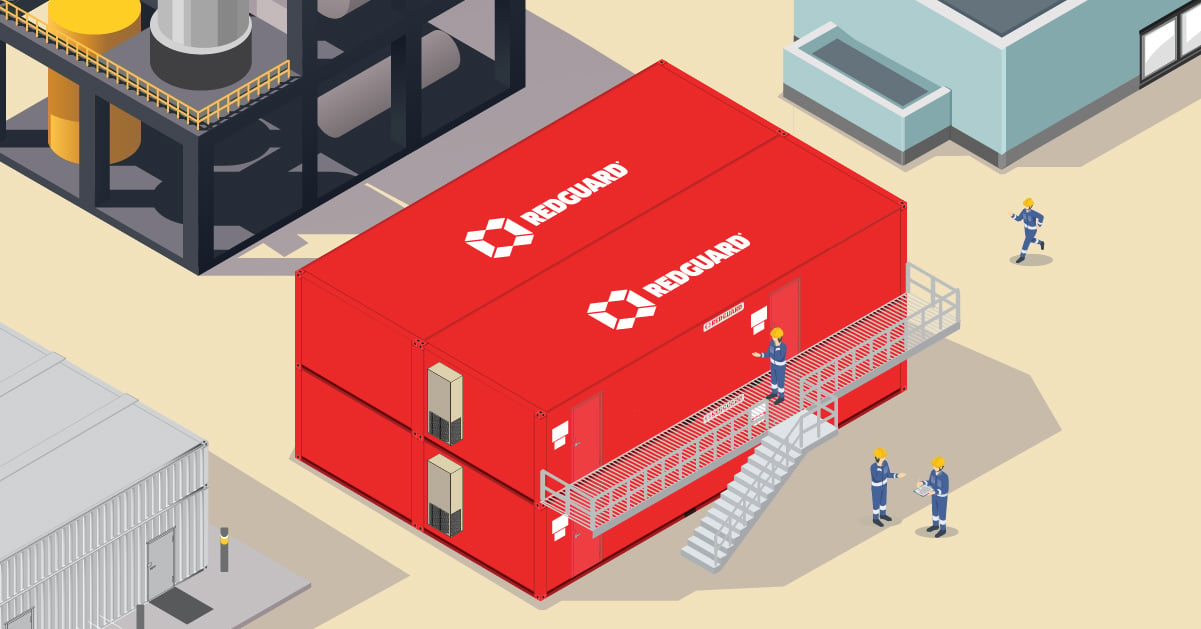

Industrial facilities rarely struggle with demand for personnel space. They struggle with where to put it.
As demand increases, projects expand, and turnarounds intensify, the number of people requiring protected occupancy grows. What does not grow as easily is the physical footprint inside an operating unit. Equipment layouts, access routes, safety setbacks, and established infrastructure limit horizontal expansion long before occupancy needs stabilize.
Stacked blast-resistant modules provide a practical alternative. By building vertically within an existing footprint, facilities can increase protected capacity without sacrificing valuable ground space. Whether supporting a long-term expansion inside an operating plant or managing a temporary surge during a turnaround, vertically integrated modular blast-resistant buildings offer a scalable path forward.
The concept is straightforward. The engineering behind RedGuard’s steel blast-resistant buildings offers a purpose-built solution that expands protected occupancy without expanding a facility’s risk.
What Stacking Blast-Resistant Modules Really Means
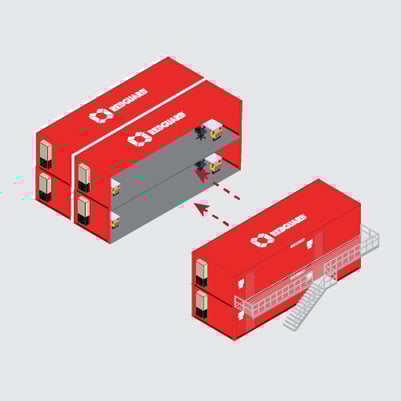 Stacking blast-resistant modules is not simply a matter of placing one building on top of another. It requires a structural system designed to safely transfer vertical and lateral loads from the upper level through the lower module and into the supporting structure.
RedGuard’s stacked configurations use engineered steel structural frames in each module. Each unit is built with its own engineered steel frame, and stacked configurations are designed so loads from the upper unit are properly supported and transferred through the lower structure. External steel stair systems provide egress pathways and access between levels.
The result is a vertically integrated blast-resistant building designed from the outset to support expanded protected occupancy. Whether deployed as a permanent installation or a portable asset, the structural performance is intentional—not improvised.
Where Stacked Configurations Make Operational Sense
Stacked blast-resistant modules are most effective in environments where horizontal expansion creates operational friction.
Brownfield Expansion Inside Operating Facilities
In established facilities, usable space is rarely open and flexible. Process equipment, pipe racks, underground utilities, access roads, and emergency corridors define the layout long before new occupancy demands arise. Expanding outward often requires relocating infrastructure, modifying traffic flow, or introducing new siting considerations.
Stacking allows facilities to increase protected occupancy within an existing footprint. Instead of consuming additional ground space, a second level adds capacity vertically while preserving access routes and equipment clearances. For long-term expansion planning, this approach reduces disruption and avoids the cascading costs that often accompany horizontal construction inside active plants.
Turnarounds and Temporary Personnel Surges
Turnarounds introduce a different kind of constraint. Workforce density increases significantly, but laydown space and staging areas are already under pressure. Every square foot on the ground serves a purpose—materials, equipment, cranes, and logistics.
In these scenarios, stacking preserves valuable ground space while still increasing protected occupancy. External stair systems provide efficient access between levels, and the modular nature of the buildings allows facilities to deploy additional capacity without permanently altering site layout.
Scalable Growth Over Time
Stacked configurations also support phased expansion strategies. Facilities can begin with a single module and add a second level as personnel requirements grow. This modular approach allows capital spending to align more closely with operational needs rather than forcing large upfront investments.
Whether permanent or portable, the ability to build upward offers flexibility that traditional single-level deployments cannot.
Structural Engineering Considerations in Vertical Blast-Resistant Design
Adding a second level changes more than occupancy. It changes how forces move through the structure and how they are resisted.
In stacked configurations, each module maintains its own engineered steel frame. However, stacking units introduces additional safety considerations beyond those present in single-story deployments. The arrangement of modules, the number of sections in each level and the connection strategy all influence system performance.
RedGuard applies specific configuration principles to support predictable blast performance:
- Upper and lower layers are typically configured with matching section layouts to maintain a balanced structure and reduce corner-induced amplification effects.
- Stacked configurations are limited to two stories to maintain appropriate structural capacity in the base layer.
- In some circumstances, a single-module-over-single-module stack may be used, typically in lower-pressure or shorter-duration blast scenarios.
- Installation requirements, including the type and quantity of connection devices between modules, are specified to ensure proper performance during a blast event.
Blast-resistant buildings are not evaluated on overpressure alone. When stacked, the whole structure must be carefully evaluated as part of the planning process.
These considerations are not theoretical. They are part of the engineering process that determines whether a stacked configuration is appropriate for a specific site. Proper analysis ensures that increasing protected occupancy does not introduce unintended structural or stability risks.
Where Stacked Modules Fit Within API Siting and Risk Assessment Practices
Stacked configurations do not bypass established siting and risk evaluation practices. They are assessed using the same framework as any occupied building located near process hazards.
For permanent installations, API RP 752 provides guidance on siting occupied buildings exposed to explosion, fire, and toxic release hazards. When stacked blast-resistant modules are deployed as long-term infrastructure inside operating facilities, they are evaluated within that same risk-based context.
For portable deployments, including turnaround applications, API RP 753 addresses the siting of portable occupied buildings exposed to explosion hazards. Stacked configurations used in temporary or redeployable applications are evaluated consistent with those principles.
API RP 756 provides methodology for evaluating and managing risks associated with temporary occupied buildings, particularly during events such as turnarounds or construction phases. Whether permanent or portable, adding a second level does not eliminate the need for a facility-specific hazard analysis. Occupancy, exposure distance, and potential blast loading remain part of the decision-making process.
The key point is not that stacking changes the rules. It’s that vertical expansion must be incorporated into the same disciplined siting and risk assessment approach used for any blast-resistant building. Proper evaluation ensures that increasing protected capacity aligns with facility safety objectives rather than working against them.
Capacity Efficiency Without Expanding Footprint
For facilities operating within fixed boundaries, ground space is one of the most constrained resources. Every additional structure competes with access routes, laydown areas, process equipment clearances, and emergency pathways. Horizontal expansion often introduces secondary impacts that extend beyond the building itself.
Stacked blast-resistant modules address capacity constraints without triggering those secondary effects. By increasing protected occupancy vertically, facilities can support larger operations teams, project personnel, or turnaround crews without consuming additional square footage at grade.
This approach is particularly valuable during high-density events. Turnarounds can significantly increase onsite workforce requirements, yet ground-level space must remain available for logistics, materials staging, and equipment movement. Vertical configurations preserve that space while still expanding protected occupancy.
For long-term planning, stacking also supports phased growth strategies. Facilities may begin with a single module and expand vertically as operational needs increase. This allows capital investment to align more closely with staffing levels and production demands rather than committing to excess capacity upfront.
In practical terms, stacking is not just a structural solution. It is a space management strategy that increases protected capacity while maintaining operational flexibility.
Planning for Vertical Growth Without Increasing Risk
Expansion inside operating facilities rarely occurs under ideal conditions. Space is limited. Infrastructure is fixed. Operational demands could increase. The ability to add protected occupancy without disrupting existing layouts becomes a strategic advantage.
Stacked blast-resistant modules provide a practical way to manage that growth. By leveraging engineered steel construction and modular flexibility, facilities can scale capacity in phases, respond to temporary workforce surges, or establish long-term infrastructure within an existing footprint.
The decision to stack is not simply about adding a second level. It is about aligning structural design, siting evaluation, and operational planning to support growth safely and efficiently.
When expansion is constrained by space, building upward can provide the capacity needed, without expanding risk.
Talk with RedGuard about stacked blast-resistant modules and how vertical configurations can increase protected occupancy within your existing facility footprint.
