


When organizations evaluate blast-resistant buildings, one of the first questions often involves blast pressure ratings. When you’ve got your facility siting study in hand, it’s important to know what the ratings mean and if they fulfill your facility’s requirements.
Is an 8 psi building sufficient for the facility's risks? What if you saw one building listed as 8 psi / 200 msec and another listed as 8 psi / 500 psi-msec? Would you know the difference? Understanding blast loads requires more than looking at a single pressure rating.
Blast-resistant buildings are engineered to perform under specific loading conditions, and those conditions directly influence everything from structural framing and connections to doors, windows, and anchorage systems. As blast loads change, the engineering requirements change. Factors such as blast duration, occupancy requirements, performance objectives, and site-specific hazards all play a role in determining how a building should be designed. This applies to temporary occupied buildings and permanently anchored buildings.
Understanding how blast loads influence building design helps facility owners, engineers, and project teams make more informed decisions when evaluating blast-resistant structures. It also explains why comparing buildings solely by their psi rating can overlook some of the most important aspects of blast-resistant design.
What Does a Blast Load Rating Mean?
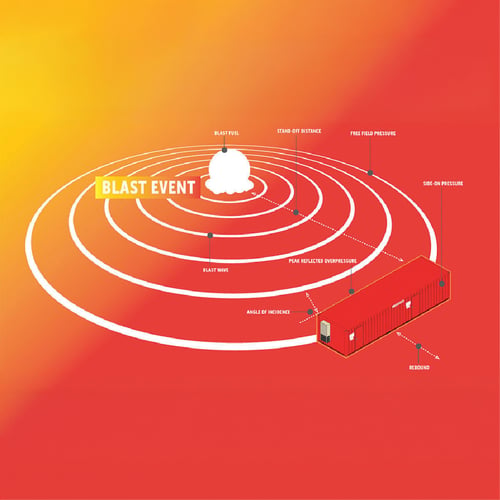
A blast load is the force that an explosion puts on a structure. So, for example, when an explosion occurs at a refinery, it creates a rapidly expanding pressure wave. That wave pushes against walls, roofs, doors, windows and the structural members of a building. The amount of force the pressure wave exerts and how long it acts on the structure is the blast load.
When we talk about blast-resistant buildings, people will often ask about the blast load rating of a particular building. This is a way of describing the force that a building is designed to withstand during a blast event. That rating would be expressed using blast pressure, measured in pounds per square inch (psi), along with either a duration, measured in milliseconds (msec), or an impulse value, often expressed as psi-msec.
While blast pressure is often discussed in general terms, engineers are primarily concerned with reflected pressure, or the increased pressure created when a blast wave strikes the surface of a building. This reflected pressure is what drives many of the structural design requirements for blast-resistant buildings.
At first glance, these ratings may appear straightforward. An 8 psi building, for example, is designed to withstand greater pressure than a 5 psi building. However, blast-resistant building design involves more than pressure alone.
The duration of the blast load can significantly affect how a structure responds. As a result, two buildings designed for the same pressure may require different structural solutions if the duration or impulse requirements differ. A short-duration blast may produce different structural demands than a longer-duration blast with the same peak pressure. Likewise, impulse measurements account for the total energy transferred during the blast event and provide additional information about the severity of the loading condition.
In the example noted earlier, there are two buildings, with one described as 8 psi / 200 msec and another listed as 8 psi / 500 psi-msec. It’s important to understand that you can’t determine which is more robust based on these descriptions alone. Without additional information, they may represent either different blast loads or the same blast load expressed in different ways. It’s comparing apples to oranges unless the blast load criteria are understood.
Because blast-resistant buildings are engineered around specific loading conditions, understanding what a blast load rating represents is the first step toward understanding how those loads influence building design.
How Are Blast Load Requirements Determined?
In most industrial environments, the design requirements for blast-resistant buildings are established through hazard assessments, consequence modeling, and facility siting studies.
These evaluations examine risk and estimate the blast loads that occupied buildings could experience in certain scenarios. Factors such as the type and quantity of hazardous materials, process conditions, equipment locations, and standoff distances all influence the projected blast loads. The result is a set of design criteria that identifies the level of protection a building must provide.
Two areas that appear similar on the surface may have very different blast-resistant building requirements. A control room located near a process unit will have a different hazard profile than an office building positioned farther away. Changes in facility layout, occupancy levels, or operating conditions can also affect the blast loads a building is expected to withstand.
The objective isn’t to select the highest blast rating. It’s to select a building, or even engineer a custom building, that provides protection appropriate for the facility's identified risks and meets or exceeds its performance objectives. Once those blast load requirements are established, including pressure, duration, and impulse criteria, they become the foundation for the engineering decisions that follow.
How Higher Blast Loads Affect Building Design
Once blast load requirements have been established, engineers can evaluate building options capable of meeting those criteria. In some cases, this involves designing a custom structure. In other cases, it may mean selecting from a fleet of pre-engineered or leasable blast-resistant buildings that are designed for specific blast loads. As blast pressure and duration requirements increase, a building's structural systems must be engineered to withstand greater forces and absorb more energy during a blast event.
 This affects nearly every component of the building. The structural frame needs to be able to resist higher loads, and so do the walls, roofs, and connections. Doors and windows must also be capable of performing under the specified blast conditions. For a building to protect at a certain level, all components must be rated for that level of performance.
The relationship between blast loads and building design is not always linear. A modest increase in the blast pressure requirement can sometimes require significant engineering changes, depending on the performance objectives and the overall blast loading criteria. Duration, impulse, occupancy requirements, and building function can all influence the final design.
This is one reason blast-resistant buildings are not interchangeable. Two buildings may appear similar from the outside while being engineered for very different blast load requirements. The design criteria established during hazard assessments and facility siting studies ultimately determine how the building is configured and how it is expected to perform during a blast event.
Why Blast Duration Matters Alongside Blast Pressure
Duration, or the length of time a blast load acts on a structure, can significantly influence how a building responds during a blast event. A brief force and a sustained force may apply the same peak pressure, but they don’t affect a structure in the same manner. The longer a blast load acts on a building, the more opportunity it has to transfer energy into the structure, which affects how the structure responds.
This relationship between pressure and duration is one reason engineers also consider impulse when evaluating blast loads. Impulse is the combined effect of pressure and duration and helps quantify the overall energy delivered during a blast event. While pressure, duration, and impulse are related, they don’t communicate the same information.
As a result, two blast scenarios with the same pressure rating may produce different structural demands depending on their duration and impulse characteristics. Likewise, two locations exposed to the same peak pressure may require different blast-resistant building solutions if one is more likely to experience that pressure in a rapid flash, while the other is more likely to experience it as a sustained event.
For this reason, blast-resistant building design is based on the complete blast load profile rather than pressure alone. Evaluating pressure, duration, impulse, and performance objectives together provides a more accurate understanding of the demands a structure may face during a blast event.
How Occupancy and Performance Objectives Influence Design
Engineers also consider whether the building is occupied and how the building is expected to perform during and after a blast event. For some facilities, the primary objective is protecting personnel from injury. Other facilities may require the building to remain operational, so critical equipment, communications systems, or control functions can continue following an incident. In some cases, maintaining operational continuity is essential for controlling the event, preventing secondary incidents, and reducing the potential impact on the surrounding community. These performance objectives can influence design decisions even when blast load requirements are similar.
Selecting a Blast-Resistant Building for Site-Specific Risks
Making informed decisions when selecting or designing blast-resistant buildings means tying all these factors together. The appropriate design depends on the hazards identified during the facility siting process, the anticipated blast loads, occupancy requirements, and the performance objectives established for the project.
Whether selecting pre-engineered structures, a leased building, or a custom-engineered solution, the goal is the same: matching the design criteria to the facility's specific risks. Doing so helps ensure that buildings can provide the intended level of protection and performance in a blast event.
By understanding how blast loads influence building design, organizations can move beyond simple specification comparisons and make decisions based on the actual needs of their facility. For a deeper look at selecting, specifying, and evaluating blast-resistant buildings, download The Ultimate Buyer's Guide for Blast-Resistant Buildings. If you're ready to discuss your facility's unique hazards, operational requirements, and performance objectives, the RedGuard team can help identify a solution that aligns with your blast load requirements and protection goals.